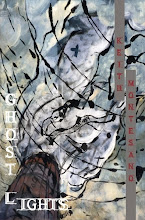
Thanks to Blake for taking what was the last unpublished poem in Ghost Lights, "Alternate Featurette, Zoo," for publication in the next issue of Lamination Colony.
It's one of my favorite poems in the book, if not my favorite, and again it's always funny how those things work out. I sent it to at least thirty places, all of them who eventually said no. It's also the longest poem in the book too, so that might have had something to do with it, and I fully understand that.
*
The contract for Ghost Lights has arrived. As soon as it's signed and in the mail and received by the editor, we can both start making official announcements.
I've already gotten a few folks (thank you thank you thank you) willing to do blurbs, and I'm still trying to round up some more. And those that don't make it on the back cover will certainly, in full, be on the blog dedicated to the book (where I'll also most likely be selling it a bit below what you'll be able to get it for online).
Maybe eventually I'll start a real website too, but for now I don't have the time, and it's still a while before the book will actually be in anyone's hands.
Now to email all the contests where the book still is and them know they shouldn't consider it anymore. Did anyone go through this and have to write official snail mail letters, or is email usually fine with them?
Monday, April 13, 2009
Sunday, April 12, 2009
Ghost Lights
It was with great pleasure and surprise that I say yes, Ghost Lights will be published by a press that I very much admire.
I wasn't the winner, but was offered publication. I have accepted, so once the details are rolling and finalized, I'll be able to announce things and such.
I'm thrilled that it didn't take me the many, many years I originally thought it would, and this way I can get on the ball for my second manuscript.
I still can't believe it. Once it's finalized I really won't be able to.
I wasn't the winner, but was offered publication. I have accepted, so once the details are rolling and finalized, I'll be able to announce things and such.
I'm thrilled that it didn't take me the many, many years I originally thought it would, and this way I can get on the ball for my second manuscript.
I still can't believe it. Once it's finalized I really won't be able to.

Wednesday, April 8, 2009
USPS
Got all the documents for Binghamton in the mail about an hour ago. Soon it will be officially official.
I also regrettably just sent my letter to Lisa Lewis, letting her know I won't be coming to OSU. I was looking forward, initially, to working with her and Ai, both of whom I respect and like so much as poets.
But there were too many factors drawing me toward Binghamton. And the crazy thing about finally making a decision is that you really never know what would've happened otherwise. I'll probably be writing different poems in New York than Oklahoma. That's the way things go. Now we can start thinking about our living situation and when we're going up there post-wedding to physically jump start the process.
I guess I'll be updating this once more and more information gets gathered over the summer and Jess and I start to make some moves. Along with the other random stuff that finds its way on here.
Oh, and I also want to thank all of the amazingly generous people who took the time to answer my many questions, the former and current students from many schools (you know if you're one of those folks or not if you're ready this). I haven't gotten the chance to do that yet for anyone, but I hope to repay the favor as I continue and other younger folks in a few years are getting ready to step up to this decision. It does end up being a big one, and I hope I put enough work into the whole process (which I'm confident of) to make the next four years of my life (and our life) good ones.
I also regrettably just sent my letter to Lisa Lewis, letting her know I won't be coming to OSU. I was looking forward, initially, to working with her and Ai, both of whom I respect and like so much as poets.
But there were too many factors drawing me toward Binghamton. And the crazy thing about finally making a decision is that you really never know what would've happened otherwise. I'll probably be writing different poems in New York than Oklahoma. That's the way things go. Now we can start thinking about our living situation and when we're going up there post-wedding to physically jump start the process.
I guess I'll be updating this once more and more information gets gathered over the summer and Jess and I start to make some moves. Along with the other random stuff that finds its way on here.
Oh, and I also want to thank all of the amazingly generous people who took the time to answer my many questions, the former and current students from many schools (you know if you're one of those folks or not if you're ready this). I haven't gotten the chance to do that yet for anyone, but I hope to repay the favor as I continue and other younger folks in a few years are getting ready to step up to this decision. It does end up being a big one, and I hope I put enough work into the whole process (which I'm confident of) to make the next four years of my life (and our life) good ones.
Monday, April 6, 2009
Official
I have officially accepted Binghamton University's offer.
I'll be a PhD Candidate in English starting in the fall. Signed paperwork in the mail on Wednesday (though the paperwork is signed and sitting here on my desk). Letting the other schools know I won't be accepting their offers also on Wednesday.
It's been a weird few months. And it's been tough to decide. I feel like a small weight is off my chest, but the weight will be back on come classes starting at the end of August.
Still, I'm excited and am ready to get this whole thing going again.
I'll be a PhD Candidate in English starting in the fall. Signed paperwork in the mail on Wednesday (though the paperwork is signed and sitting here on my desk). Letting the other schools know I won't be accepting their offers also on Wednesday.
It's been a weird few months. And it's been tough to decide. I feel like a small weight is off my chest, but the weight will be back on come classes starting at the end of August.
Still, I'm excited and am ready to get this whole thing going again.
Weekend & Dan Deacon
Two of my best friends from high school, Chad and Wes, were here for the weekend. They took off about an hour and a half ago to see another mutual friend from high school. We had a good time. Good people came over. The cops only had to come by once for a minor noise complaint. Get eight people on a third floor balcony and yes, the sound will carry more loudly than anticipated by said eight people. They were cool, though, and we toned it down before we left again.
*
Very close. Imminently close to finalizing PhD plans. Most of you reading this probably already know where it's going to be, but I'd rather wait until sheets of paper are signed and faxed and in the mail and all of that.
*
Saw Dan Deacon last night @ William & Mary last night. It was only about an hour away, so we thought we'd take it easy and check it out. Their bus broke down, so they got there a bit late. Luckily, so did we. The back-up band for Dan Deacon was mostly comprised of members from the two opening bands, Teeth Mountain and Future Islands. The former was interesting, if a bit too noisy and avant-garde for me by the end of their one-long-song set. Future Islands is doing the whole bass-singer-keyboard thing, with a lot of pre-programmed drums. I found them a little boring honestly.
Finally Dan Deacon and crew got set up, but Dan was making sure everything sounded perfect before they started, so they sound-checking was seemingly interminable. But as Wes and I talked about, it ended up being necessary. When you have four keyboards, two drum kids, bass, guitar, other sound samples, a marimba, bells, and more, everything has to click. And yes, it did. Most of Bromst was played, and all of it sounded incredible, once again considering how many sounds comprised some of the extreme loudness.
If you don't know much about his shows, and I didn't, Dan likes to play in front of the stage. He puts all these epileptic-inducing lights up and fucks with those as different parts and choruses are going on. And he's also got tons of pedals and weird effects-driven modules on this table, along with a glowing green skull he puts a light bulb in.
At one point he had the crowd almost doing warming-up exercises. We were a bit hungover and too old, or felt like it at least. We preferred to stay off to the side. Especially when the two drummers were doing their thing, some of it mind-blowing to watch. But at one point he had people holding hands above each other's head, and people could continue that trend while going through the gauntlet, and the giant worm of hands ended up snaking around the whole venue (called The Little Theater, though it was kind of a smaller but larger gymnasium), and then almost everyone was outside in the hallway doing it. It was wild to watch.
The whole thing was an experience, and he didn't point us out as the non-participating, which was nice, and which I was certainly afraid of.
There are many tour dates left. Get Bromst. And go see him. It was beyond worth it, and a blast.
*
Digging the new Pop Ambient 2009 compilation from Kompakt. Along with the remastered and bonus-tracked Raise by Swervedriver. One of my favorite all-time records.
*
I want to melt all the guns in the world and build metal houses for people who need houses but don't have houses.
I'm sick of all these shootings and massacres. No one needs to own a gun. Use a crossbow if you want to hunt.
*
Very close. Imminently close to finalizing PhD plans. Most of you reading this probably already know where it's going to be, but I'd rather wait until sheets of paper are signed and faxed and in the mail and all of that.
*
Saw Dan Deacon last night @ William & Mary last night. It was only about an hour away, so we thought we'd take it easy and check it out. Their bus broke down, so they got there a bit late. Luckily, so did we. The back-up band for Dan Deacon was mostly comprised of members from the two opening bands, Teeth Mountain and Future Islands. The former was interesting, if a bit too noisy and avant-garde for me by the end of their one-long-song set. Future Islands is doing the whole bass-singer-keyboard thing, with a lot of pre-programmed drums. I found them a little boring honestly.
Finally Dan Deacon and crew got set up, but Dan was making sure everything sounded perfect before they started, so they sound-checking was seemingly interminable. But as Wes and I talked about, it ended up being necessary. When you have four keyboards, two drum kids, bass, guitar, other sound samples, a marimba, bells, and more, everything has to click. And yes, it did. Most of Bromst was played, and all of it sounded incredible, once again considering how many sounds comprised some of the extreme loudness.
If you don't know much about his shows, and I didn't, Dan likes to play in front of the stage. He puts all these epileptic-inducing lights up and fucks with those as different parts and choruses are going on. And he's also got tons of pedals and weird effects-driven modules on this table, along with a glowing green skull he puts a light bulb in.
At one point he had the crowd almost doing warming-up exercises. We were a bit hungover and too old, or felt like it at least. We preferred to stay off to the side. Especially when the two drummers were doing their thing, some of it mind-blowing to watch. But at one point he had people holding hands above each other's head, and people could continue that trend while going through the gauntlet, and the giant worm of hands ended up snaking around the whole venue (called The Little Theater, though it was kind of a smaller but larger gymnasium), and then almost everyone was outside in the hallway doing it. It was wild to watch.
The whole thing was an experience, and he didn't point us out as the non-participating, which was nice, and which I was certainly afraid of.
There are many tour dates left. Get Bromst. And go see him. It was beyond worth it, and a blast.
*
Digging the new Pop Ambient 2009 compilation from Kompakt. Along with the remastered and bonus-tracked Raise by Swervedriver. One of my favorite all-time records.
*
I want to melt all the guns in the world and build metal houses for people who need houses but don't have houses.
I'm sick of all these shootings and massacres. No one needs to own a gun. Use a crossbow if you want to hunt.
Thursday, April 2, 2009
Wednesday, April 1, 2009
Things I've Learned and Experienced from Submitting Poetry to Journals Within the Last Four Years (In No Particular Order)
I've been thinking about doing a post like this for a while now, mainly because I always find it interesting to hear about peoples' experiences and stories about submission (hence my obsession also with Kate's first book interviews, followed with my own). Also, I've learned a lot from that in many ways. Keep in mind your experiences may differ, so there's no point in saying, "Well, that's never happened to me." This is first person here, folks.
I would be interested in hearing others' thoughts on this too. Feel free to disagree with me or add a bullet point of your own in the comments field if you're interested.
Here we go:
I would be interested in hearing others' thoughts on this too. Feel free to disagree with me or add a bullet point of your own in the comments field if you're interested.
Here we go:
- Discouragement is for suckers. If you can't take rejections, maybe this whole thing isn't for you. First and foremost. Out of the way.
- Many online journals are just as good (if not better, at this point) as many print journals. Read around in online journals and take advantage of being able to see everyone's work without having to get a subscription or buy an issue.
- Along with the former post, buying subscriptions to journals, or even if they're back issues, is supportive and positive and encouraged. Read some stuff online as far as current issues go, and buy a few subscriptions to the journals you like. And back issues, sometimes less than six months old, are cheap to get a hold of.
- Then again, don't buy into the "Read an issue before you decide to send to us" hype. Is it a good idea? Sure. Does it truly give you a sense of whether they may publish a poem or more from a batch that you send to them for consideration? Most often not. I've sent to journals that many have told me probably wouldn't be right for my work. And sometimes they took something. There are too many factors involved, especially when sending the same work to a number of journals. Manuscript submissions of poem batches are much cheaper, and therefore can be more can be more of an affordable risk, than book contests.
- Take advantage of the Online Submissions Manager, which many journals use, and print journals that take submissions by email. With a recent batch I sent out, I found out that Sou'wester and Indiana Review now take submissions via Submissions Manager, which I didn't know even two weeks ago. And there are more and more popping up week by week. It saves time, money, and gas to drive to the post office. Plus, the quicker the rejection, the happier you were that you didn't waste the postage. And the quicker you can write the name down on your "Where to Send Next" list.
- Keep. Good. Records. Especially if you're like me and you like to have work out as much as you can (as long as I have work to send out, of course). I have a system many would scoff at, as it's primarily a physical system, binder-clipped, with a pen the main tool to cross off rejections. Then the name of the journal goes on the aforementioned "Where to Send Next" list (though I don't call it that, as it's just an example). A lot of people use some form of a Spreadsheet. Use whatever works best for you, but make sure you keep good records. It's imperative.
- Along with the last point, as soon as you hear that a poem has been accepted elsewhere, notify every journal you sent that poem to immediately. I know too many people who don't do this, for various reasons, and I imagine they've pissed off many editors in the past. You can also spin your speediness into a positive; maybe it will get an editor to move your poems to the top, or to take a second look at a batch they previously thought they'd most likely reject.
- Find out where your favorite newer poets are publishing. Look at Acknowledgments section in their first or second books. I've discovered a few journals I didn't know existed by doing this.
- Don't take solicitation to mean, "I'm an editor that's going to publish you if you send me more work." You should be flattered that someone wants to actually take some time to consider your work beyond the slush pile in the first place.
- Just because a journal sends you a form rejection letter the first nine times, it doesn't mean they won't take a poem or more on the tenth (and this also goes for two and three or five and six...). Sometimes it takes only one time. Sometimes it takes twenty. When you have new work, and if you like their journal, keep sending.
- Duotrope can be interesting, but don't take it to heart. So many people don't report statistics. Most report only when they have an acceptance. But it's always nice to know, generally, how many days it takes for a journal to send a rejection versus an acceptance. Sometimes the stuff you've had out for six-plus months is still being considered. Maybe not all of those rejections got lost in the mail.
- If a journal says, "No Simultaneous Submissions," don't send them simultaneous submissions. This is something I've debated about, as I'm sure everyone has. And if the worst case scenario is getting blacklisted by a prominent journal such as The Georgia Review (completely off the top of my head, and also a journal I'd love to get into but have never sent to because they don't consider simultaneous submissions), it's not the worst thing in the world. There are many more journals. And life will go on. But those editors are reading your work thinking they're the only place considering your work. So if they accept something a day later after you've already committed to journal X, they're going to be pissed, and they're going to wonder why you sent work to their journal. I could rattle off the names of ten to twenty journals right now I wish I could send work to, but 1) I want to respect their rules, 2) I don't write as many poems as Bob Hicok or Seth Abramson, and 3) I don't think I'd get into many of them in the first place. My opinions may change very soon; who knows. But for now, there are so many journals out there who do accept simultaneous submissions, great journals with great editors, that it can become nearly impossible to find enough to send to if you have a ton of good poems you think are worthy and publishable.
- Despite the horrific term "croneism," which sounds like something a psychologist would use to me, or something cavemen used to formulate gutturally how many thousands of years ago around a campfire, having friends and acquaintances as editors is not a bad thing, and if you can use it in your favor, don't be ashamed of that fact. This is null and void when it comes to book contests, when anonymous judges should be reading anonymous manuscripts, though exceptions and luck and finger-pointing, despite many of the situations being benign, can certainly happen.
- A poem doesn't have to be polished until pulverized before it's sent out to poetry editors at a journal for consideration. There's a reason that most books have a little note after the Acknowledgments page that reads something like, "sometimes in earlier versions, earlier forms, different versions, different forms, etc." I've been known to write a blog post or two in the past about my interest in journal publication to book publication. And let's be serious, if you're saying, and you probably should be in the realist sense, "Who's going to read my book," then really, who's going to be reading this journal where my poem's published? Again, this is not meant to be reductive.
- Which brings me to a next point: Don't Be Afraid to Show the Love. Most journals are read by people interested in what's between the pages. Often these people are in school, and they're reading for any number of reasons. The point is: they're reading, and maybe your work, and that's great. But if you like something, or something rips out your aesthetic jugular, it's fairly easy now to contact people. Email. Facebook. Faculty pages. TheirName.com. Maybe it's just me, but when I find work I really love, I take the time to let those people know. It doesn't happen as often as one may think, but more often than some may think. As an example, keep an eye out for the poet Bobby C. Rogers. When I began as an MFA student, I read some poems, in journals I luckily had subscriptions to, of his and was completely blown away. After some searching, I found his email and emailed him, and he responded. I think his first book, when it comes out, is going to be one of the best first books of poetry this decade. The guy's amazing. And when I was checking my status on the Anthony Hecht Prize from Waywiser Press (I should be receiving the form rejection letter soon I imagine), I found out that Bobby C. Rogers was a finalist. His poems are theological and metaphysical, but they're all grounded in an effort of planting shrubs or doing work outside the house to finish a garden. It's seemingly simplistic but beautiful and amazing and relevant and wowing poetry. I can't wait until I hear the imminent news that his book will be published. And THIS is one of the reasons that reading journals can go beyond the normal turn-on-the-light-and-flip-through-this-sucker kind of post-dinner activity. Also it would be awful of me not to mention brother-in-arms Blake Butler, who, even though he's primarily a fiction writer, struck a chord in my writerly senses how-many-months-ago, if not beyond a year now (even though he still never calls me back). And he's opened me up to a new world of fiction, and new contacts, I would've otherwise probably never discovered. So don't be shy when you want to tell someone they've ripped your aesthetic head off. I could go on with more examples, but you're probably already done with this, so I won't.
- Maybe this is just me here, because I know, speaking of Blake, that he dealt with a situation like this, but as far as a poem's concerned, if the changes are minor, let the editor make positive changes, as long as it doesn't jeopardize what you're trying to say. If it does, or it's completely unreasonable, then tell them you'll be taking it elsewhere. But as someone wise once said to me, "What's really going to matter is how the poem looks in a book." I've seen books as much as 50% completely different than the original published poems in journals, and 100% the same. But there's always a little weight that gets released off the shoulders, off the chest, when a poem's published, sometimes whether you're working toward a book or manuscript or not.
- Addendum to the last: Publication can be the fuel for new work. It doesn't have to be. It isn't always. For some it may never be. But I've always said that if poems are published, or a lucky streak comes along and you have a good week or a good month, that you feel the need to start writing new poems. If no one ever sees your poems, if no one ever hears your poems, then you may be working on them for who-knows-how-long, which can be great. But like the under-read, still-amazingly-relevant Joe Bolton, I prefer to write new poems, to challenge myself, to purge myself of work that's been lying around sometimes forever, that needs at least some semblance of finality before I can move on. I've reworked poems to death even post-publication, but having it published, either electronically or on the printed page, can help you move on to positive and challenging new ways of thinking.
- This may be the last one. I've probably already exhausted this beyond belief. But I've seen it too much lately, or if not seen, have heard about it too much lately. Someone in an MFA program, who's busting their ass, taking their own reigns, wants to get their work out there, is doing just that, and is being successful. And they're brought down by their peers because of it. The word "Po-Biz," and what an ugly word it is, has triggered so much negativity lately. We write poetry to share our words, and we do something few folks understand or appreciate or care about or whatever the hell it is. And within that small percentage, there's a lot of folks bringing down others within the circle. Maybe it's Darwinian. I'm not sure. But life's too short not to be supportive of people who deserve it. So be supportive. We all know people who've made contacts and who have ridden that wave of poetic rock stardom to... maybe some adjunct teaching jobs in small southern towns? And really, is a $25,000 NEA fellowship really so much money that you're jealous of someone because they got it over you? If it is, fine, then be that way.
Subscribe to:
Posts (Atom)